
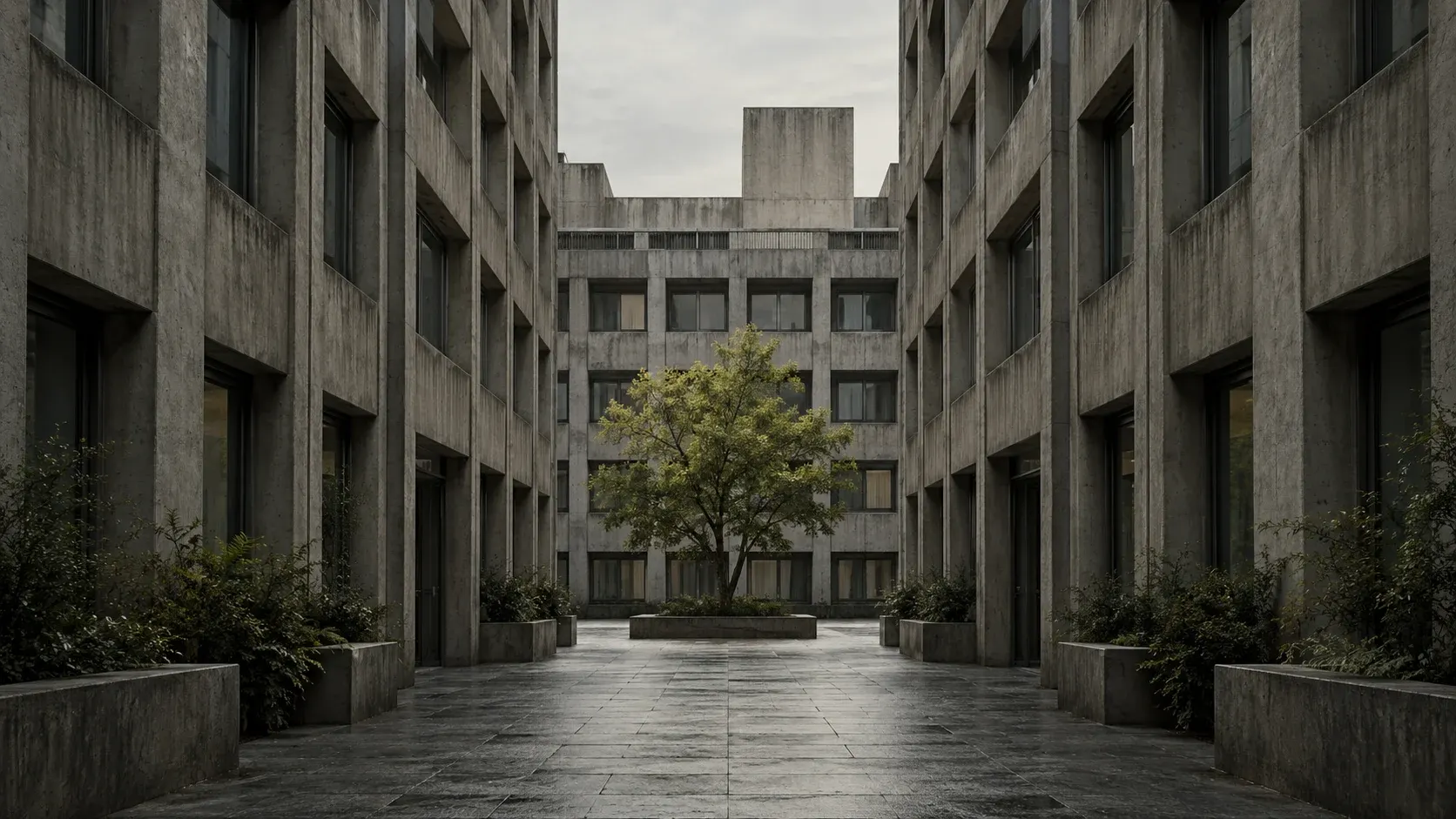
A fictional society can feel wrong before anyone explains its rules. A corridor is too orderly. A conversation ends when a third person enters. Everyone waits for permission to do something that looked ordinary a moment ago. Those small choices can carry a world more effectively than a long account of its history.
When watching a dystopian film, it is useful to ask how everyday life has been arranged. The question turns attention away from the size of the buildings and toward the people who are allowed to move through them.
Start with the spaces people share
Look at entrances, queues, dining rooms, and public gathering places. Who occupies the center? Who stays near a doorway? Does a room invite conversation, or position people so they can only face forward?
Imagine a school dining hall in which every chair points toward a blank wall. Nobody explains the arrangement, and the meal proceeds politely. This invented scene does not need an announcement about control. The placement of bodies has already introduced a question about what the institution expects.
Architecture alone cannot answer that question. A symmetrical room might be comforting in one scene and oppressive in another. The characters’ behavior gives the space its meaning. Notice what happens when someone breaks its pattern.
Watch a routine twice
The first appearance of a daily ritual teaches the viewer how things work. A later repetition can reveal who has changed. A gesture that once looked effortless may become hesitant. The setting can remain almost identical while the viewer’s understanding shifts.
On a second viewing, choose a recurring routine and compare its appearances. What changes in the framing, the sound, or the time spent on it? What stays stubbornly the same? You do not have to identify a technical term to describe a meaningful difference.
Try writing a plain observation: “The second version stays with the person waiting after everyone else has left.” That sentence gives you something to discuss. A broad label such as “darker atmosphere” does not yet explain how the scene produced it.
Listen for what belongs to the system
An announcement can be friendly in tone and restrictive in purpose. A recurring signal can make people move without anyone visibly giving an order. Listen to which sounds the characters notice and which they treat as part of the background.
Silence also needs context. It may offer privacy, mark an absence, or make a room feel monitored. Ask who is allowed to interrupt it. If one person can speak freely while others wait, the sound of the scene has already established an imbalance.
Follow an ordinary object
A cup, a coat, or a handwritten note can become interesting because of where it is permitted to go. Rather than assuming that every object is a symbol, track how people use it. Who owns it? Who can touch it? What happens when it changes hands?
Color deserves the same patience. A vivid object in a muted scene draws attention, but attention is the beginning of an interpretation, not its conclusion. Look for repetition and consequences before deciding what a color means. A single frame rarely settles the matter.
Three questions for the end credits
- What was treated as normal? Name a routine the film initially invited you to accept.
- Who had room to choose? Find a moment when two people faced different consequences for the same action.
- What changed your view? Identify a scene that made an earlier detail look different.
These questions work best when attached to scenes rather than to a plot summary. You may disagree with another viewer about what a choice means and still agree on what the film shows. That is a useful place for a conversation to begin.
If the film comes from a novel, compare how each version introduces the same routine. Our book-to-screen reading guide suggests a way to make that comparison without reducing it to a list of omissions. For a related reading project, explore The Giver quartet.